Savvy short-term rental investors already understand the value of depreciation, cost segregation and bonus depreciation.
So when comparing STR markets, it's natural to look beyond projected rental income and ask another important question:
How much of my investment can actually be depreciated?
That's where the Outer Banks can look a little different.
In many coastal communities throughout the OBX, the land underneath a property can represent a substantial portion of the property's total value. And because land itself isn't depreciable, an investor comparing properties across several markets might initially look at that land-to-improvement ratio and see a disadvantage.
But there's another way to look at it.
What if that high land value isn't the weakness in the investment—but one of its strengths?
You're Buying More Than a Rental Property
Consider an investor comparing STR opportunities in several markets.
In one market, a $900,000 property might have:
$150,000 in land value
$750,000 in depreciable improvements
Now consider a $1.2 million Outer Banks property with:
$500,000 in land value
$700,000 in depreciable improvements
From a cost-segregation perspective alone, the first property certainly looks attractive.
A larger percentage of the acquisition is depreciable.
But look at the actual investment.
The Outer Banks property may still provide approximately $700,000 of depreciable basis from which cost-segregation opportunities can potentially be identified.
Meanwhile, the investor also controls $500,000 worth of highly desirable coastal land.
That changes the conversation.
Two Different Parts of the Investment. Two Different Jobs.
One of the most compelling ways to look at an Outer Banks STR is that the investment has two components working toward two different objectives:
THE IMPROVEMENTS
The house and qualifying property can potentially provide:
Rental income + depreciation + cost segregation opportunities + potential tax advantages
THE LAND
The land can potentially provide:
Scarcity + location value + appreciation + long-term asset value
The land doesn't provide depreciation.
But it isn't supposed to.
Its job in the investment is different.
And in a mature coastal market where desirable land is finite, owning a larger piece of the investment in the underlying real estate isn't necessarily something an investor should view negatively.
Scarcity Matters
You can build another house.
You can't manufacture another oceanfront lot.
You can't create another soundfront parcel.
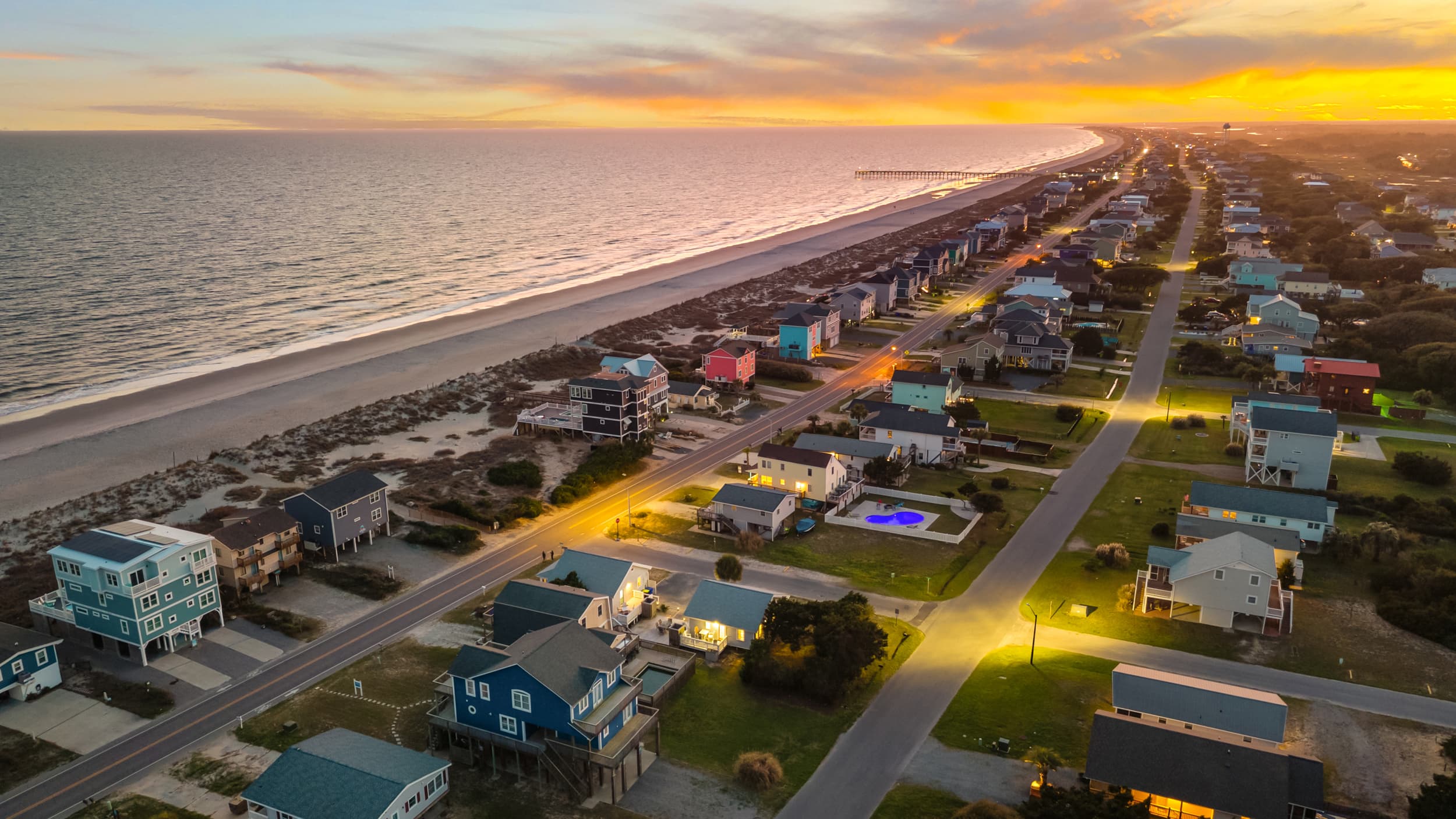
And you certainly can't add another mile of coastline to the Outer Banks.
That scarcity is part of what makes the underlying land valuable in the first place.
When investors compare STR markets based heavily on cash-on-cash returns and tax advantages, it's easy to overlook what they're actually acquiring underneath the income-producing structure.
A market with inexpensive land may offer a greater percentage of depreciable basis.
But a greater depreciation percentage doesn't automatically make it the stronger long-term asset.
The better question is what the investor receives from the entire acquisition.
And the OBX Structure Can Still Carry Significant Depreciable Basis
High land values don't necessarily mean there's little left to depreciate.
Outer Banks vacation rentals can be substantial properties.
Six, eight, ten or more bedrooms aren't unusual in portions of the market. Properties may include pools, extensive outdoor improvements, multiple HVAC systems, appliances, furnishings, flooring, electrical components, fencing and other assets.
A qualified cost-segregation study determines which portions of the investor's depreciable basis qualify for accelerated depreciation.
So even when the land represents a meaningful percentage of the purchase, the dollar amount of depreciable property can still be significant.
That's an important distinction when comparing markets.
Don't just compare the percentage of the purchase price attributable to land.
Compare the actual depreciable dollars alongside the quality and value of the underlying land you're acquiring.
The Tax Benefits Don't Disappear Because the Land Is Valuable
For an STR investor already using cost segregation as part of an acquisition strategy, the Outer Banks doesn't require abandoning that strategy.
It simply adds another component to it.
Depending upon the investor's individual circumstances, an STR may still provide substantial depreciation opportunities, including accelerated depreciation of qualifying components identified through cost segregation.
And for qualifying short-term rental owners who materially participate, the treatment of those losses can potentially be especially valuable.
The tax strategy is still there.
You're simply pairing it with a larger investment in potentially appreciating coastal land.
Think Beyond This Year's Deduction
There's another reason this distinction matters.
Cost segregation largely affects when an investor receives depreciation deductions.
It accelerates deductions that otherwise would generally be received over longer periods.
But an investment property's success isn't measured by one tax year.
An investor may own that property for five, ten, fifteen or twenty years.
During that time, the questions become much bigger:
What income did the property generate?
How did rents perform?
How much principal was paid down?
What tax benefits did ownership provide?
And what happened to the value of the underlying real estate?
That last question is exactly why expensive land shouldn't automatically scare an investor away from the Outer Banks.
Maybe the Better Comparison Isn't Tax Benefit vs. Land Value
Maybe it's:
Tax benefits + rental income + scarce coastal land.
An investor evaluating several STR markets doesn't necessarily have to choose between a property offering depreciation benefits and one sitting on valuable real estate.
The Outer Banks can potentially offer both.
The depreciable portion of the acquisition can continue working through rental income and potential tax advantages.
The land underneath it can serve an entirely different purpose in the investment—providing ownership in a finite, highly desirable coastal market.
And that may be the part of the equation that gets overlooked when markets are compared strictly through a spreadsheet.
The Savvy Investor Looks at the Whole Asset
Cost segregation matters.
Cash flow matters.
Rental demand matters.
But so do scarcity, location and the value of the underlying real estate.
The strongest STR investment isn't necessarily the property that produces the largest first-year deduction.
It's the property that best fits the investor's complete wealth-building strategy.
For investors already searching STR opportunities across multiple markets, the Outer Banks deserves a closer look.
Not despite its high land values.
Perhaps, in part, because of them.
This information is provided for general educational purposes only and is not intended as tax, legal or investment advice. Tax treatment varies based on the property and individual investor. Investors should consult their CPA, tax adviser and qualified cost-segregation professional regarding their specific circumstances.
Stacey grew up on the coast of NC, while in college she took real estate courses and in the Spring of 1998, became a licensed agent. Since then, she has continued to be a full-time Realtor. While being active in her community through volunteering and supporting organizations she believes in, she has also worked to strengthen the local REALTOR body through leadership roles to help promote and protect homeownership. As a wife, mother & grandmother, Stacey knows what to look for in making a house the perfect HOME. As an experienced agent she knows just how to make that happen. As a STR investor, owner and manager, Stacey understands ALL the important factors in regard to quality properties, ideal location and even potential resale! As a woman of strong Christian faith, she believes in helping others and always being ethical. Stacey has a passion for real estate and design which she brings to life in her own investments and enjoys helping investors realize their own dreams and goals through investing. Her goal is always SUCCESS and success for her means working with clients time and time again as their needs grow and change. She has worked hard to secure the Top Producing Agent spot in her local firm for many years consistently. Most recently she was recognized by RealTrends as being in the TOP 1.5% of ALL agents and teams Nationwide! In her free time Stacey loves spending time with family, which includes her husband and two sons who have beautiful families of their own including her three grandchildren who she adores!! Stacey also enjoys flying airplanes and as a student pilot has flown solo and plans to continue flying to pursue her pilot’s license. She loves to travel but always enjoys returning home to spend time with family!!